
Montage Health: A Decade of Kanban-Driven Supply Chain Growth
How a Community Hospital Grew From Manual Par Carts to a 24,000-Bin, Analytics-Driven Kanban Program

At a Glance
- 153 BlueBin supply nodes in active use, 122 inside the hospital, and 31 across off-site Montage on the Go (MOGO) clinics
- 24,000+ bins under active management, with the program continuing to expand
- More than a decade of partnership, since adopting BlueBin’s two-bin Kanban system in 2015 to replace a manual, paper-driven process
- A five-category analytics framework (healthy, stale, slow, hot, critical) that lets the team adjust PAR levels proactively, before a stockout happens
- A Workday ERP migration completed without relabeling a single one of the program’s 24,000+ bins
The Challenge
Before BlueBin, Montage Health ran inventory replenishment on an old PAR Excellence system paired with a 1989 version of Lawson, using metal probes and a wand to record depleting inventory transactions. “It worked,” said Van Le, Director, Supply Chain Services at Montage Health. “It just required several manual steps.”
That manual overhead showed up everywhere it usually does in a growing health system: clinical staff spending time walking to storerooms instead of with patients, inconsistent visibility into what was actually running low, and no easy way to scale consistent replenishment across a hospital and a growing footprint of off-site clinics. By 2013, those limitations were clear enough that Montage Health began actively looking for a better solution.

Why BlueBin, and Why Now?
Montage Health adopted BlueBin’s two-bin Kanban system in 2015, replacing the manual PAR Excellence process with handheld-scanned replenishment. The rollout wasn’t a single event: about five years in, Montage Health revised its standards for which products the program should manage at all, requiring that an item be purchased at least once a quarter to qualify. Lower-usage items stayed available to departments, just as “non-BlueBin” items the department owned and managed directly, rather than crowding a Kanban system built for high-turn supplies. That discipline paid off sooner than anyone expected. Shortly after completing a major optimization project, Montage Health’s supply chain was tested by COVID-19. The stability and clinical trust the team had already built let them respond immediately, standing up real-time crisis dashboards within about a week to track PPE and critical supplies across the health system. Read that story in BlueBin’s 2021 post, “Enhancing Healthcare Supply Chain Resilience Post-COVID-19.” What started as a replenishment fix became the operational backbone the team leaned on when it mattered most, and it’s continued to mature ever since.
The Solution
The program’s day-to-day discipline is best explained by the two people who run it: Van Le, Director, Supply Chain Services, and Rebecca Interrante, Assistant Director, Supply Chain Services, at Montage Health.
Scale and Structure
Today, Montage Health manages 153 BlueBin supply nodes, 122 inside the hospital and 31 across its off-site Montage on the Go (MOGO) clinics, totaling more than 24,000 bins. Two central supply technicians begin scanning at 4 a.m. and typically finish by 7:30 a.m., using handheld TC78 devices to round the units and process replenishment. Sourcing runs on a hybrid model, primarily Low Unit of Measure (LUM) ordering through Medline, supplemented by traditional distributor and direct-from-manufacturer purchasing where usage or purchasable unit of measure calls for it.
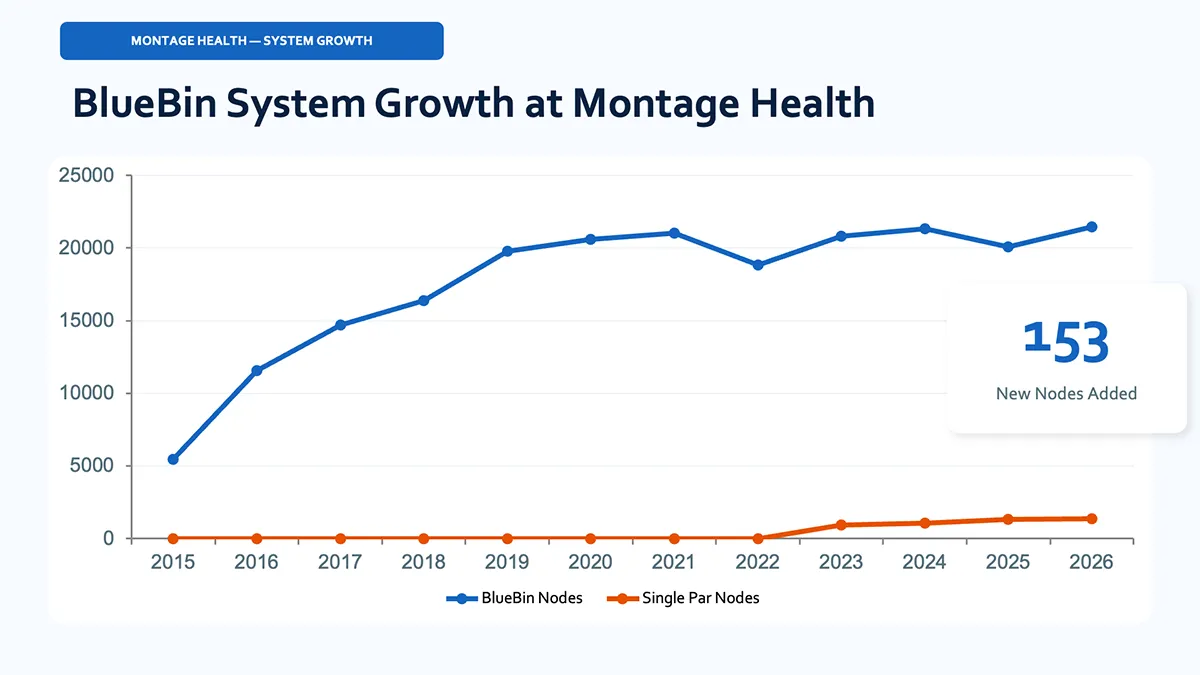
Most locations run a two-bin system that naturally enforces first-in, first-out (FIFO) rotation. A smaller number of single-bin locations remain due to space constraints, and Montage Health’s goal is to convert the rest to two-bin locations by the end of this year.
A System Built to Migrate Without Disruption
When Montage Health recently transitioned its ERP from Lawson to Workday, the team integrated directly with BlueBin using a combination of APIs and flat files. That planning meant they didn’t have to relabel any of the program’s 24,000+ bins, preserving the exact operational workflow clinical staff already knew and trusted.
Labeling and FIFO, Designed for the Floor
Each bin carries a nurse-friendly clinical description (developed in partnership with clinical champions) alongside the ERP item number, a node and sequence label identifying its exact rack, shelf, and position, and a barcode encoding the assigned PAR and purchasable unit of measure. Technicians cross-check the manufacturer number before filling a bin to avoid human error, and substitute products are clearly flagged with a label that ties back to the team’s daily, five-minute procurement huddle.
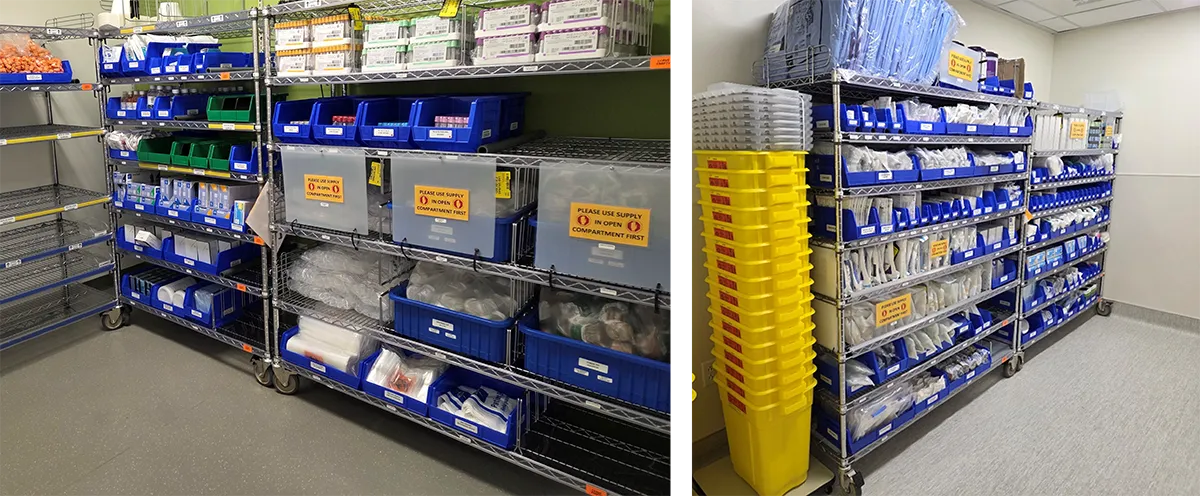
Montage Health node examples
For larger items that don’t fit a standard bin, Montage Health uses yellow Kanban cards with minimum-quantity triggers, along with sliders and flippers that visually enforce FIFO rotation on the shelf. Replenishment itself happens through SmartScan: a QR-coded smart sheet auto-populates the company, location, and cost center, and scanning the cards and bins generates the requisition directly in the ERP, all from a handheld device on the unit.
Extending the System Internally
Last year, Montage Health applied the same Kanban discipline to its own team’s build supplies, the shelving, dividers, zip ties, and cards used to construct new supply nodes, managing them with the same two-bin, SmartScan-driven process used across the hospital.
Governance That Scales With Demand
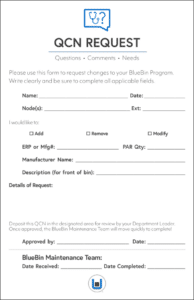 Change requests are submitted via a form Montage Health calls a QCN (Questions, Comments, Needs), which requires clinical leadership approval before an item is added, removed, or adjusted. That approval step protects space, cost, and inventory integrity while keeping departments accountable, and Montage Health tracks QCN volume, completion, and rejection by year and by team member to understand both clinical demand and internal team capacity. A digital version of the QCN is in pilot but not yet ready for full rollout.
Analytics That Drive the Next Decision
Montage Health’s BlueQ Analytics platform sorts every item into one of five health categories: healthy items are rotating as intended and need no action; stale items haven’t scanned in 180-plus days and are pushed for removal; slow items (90 to 179 days) typically get their PAR cut in half; hot items, consumed within the shadow of their own lead time, get a PAR increase of about 50 percent; and critical items, at the highest risk of a double-bin stockout, get their PAR at minimum doubled. Supporting all of it is an internal project tracker (PMT) that plans roughly 12 months ahead and is typically booked more than two years out, adjusted as urgent clinical needs arise.
Sustaining a program at this scale takes real staffing investment: Montage Health has found that two dedicated full-time employees is a minimum for its size and volume, with four being the sweet spot, a Program Manager providing consistency and accountability, supported by Kanban Specialists who execute day-to-day changes.

The Results
More than a decade in, Montage Health’s BlueBin program has grown from a single manual workaround into a structured, analytics-driven discipline that clinical staff notice in their daily work.
- 153 active supply nodes and 24,000+ bins across the hospital and off-site clinics, with the program still expanding.
- A completed Workday migration with zero bin relabeling required, thanks to a planned API and flat-file integration.
- A five-category analytics framework that shifts PAR management from reactive to proactive, catching hot and critical items before they run out.
- A governance process (QCN) mature enough to track requests, approvals, and rejections by year and by team member, giving leadership real visibility into clinical demand.
- Consistent, independent praise from frontline staff across three different care settings.
Kim V., Lead Nurse in Montage Health’s Family Birth Center, described the impact directly: “Since implementing the two-bin Kanban method, the supply room has become more organized, and supplies are easier to locate, allowing nurses to remain focused on patient care. Supplies are replenished more efficiently, reducing the need to retrieve items from other supply areas. The first in, first out process has also helped decrease product waste, while supply quantities now more accurately reflect actual unit usage.”
Cherie H., Clinic Manager for Montage Health’s off-site MOGO clinics, echoed the same theme in a faster-paced setting: “It has made a tremendous difference in the efficiency of our busy clinic. It keeps our supplies organized and ensures we have what we need, when we need it. The ability to adjust PAR levels helps reduce waste while preventing us from running out of essential items.”
Two bin Kanban has transformed the way we manage our supplies. The ease of use allows our clinical staff to focus on patient care, and less on supply ordering and management. Sarah C., Surgical Services Director, Montage Health
See how a two-bin Kanban program could work for your health system. Explore BlueBin’s Two-Bin Kanban solution or try the Supply Chain ROI Calculator to estimate your own projected savings.
Ready To Get Started?
Contact us today to discuss your our 2-Bin Kanban systems and supply chain analytics for healthcare!