
Walter Reed National Military Medical Center: 79% Fewer Supply Staff, $5.2M Recovered
How BlueBin’s Two-Bin Kanban System Helped a Flagship Military Medical Center Cut Supply Staffing 79%, Return 40% of Clinicians’ Time to Patient Care, and Recover $5.2M in Excess Inventory

At a Glance
Overall Fill Rate
Fewer Managed SKUs (38,915 to 8,641 Kanban Bins)
Clinician Time Returned to Patient Care
Fewer Supply Function FTEs (67 to 14)
One-Time Excess Inventory Recovered
Expired/Wasted Product (Down From $71,636)
The Challenge
Walter Reed National Military Medical Center (WRNMMC) is the flagship medical treatment facility of the Military Health System (MHS), part of the Defense Health Agency (DHA). As DHA’s MEDLOG division worked to modernize, standardize, and unify supply chain management across the Military Health System, WRNMMC’s supply operation showed the scale of the challenge: 67 supply function personnel managing 38,915 individual SKUs across the medical center, with no standardized, data-driven way to know what units actually needed on hand.
The cost of that gap showed up on the floor, not just on a balance sheet. Clinical staff described spending hours a day on tasks unrelated to patient care. “Before BlueBin, I was spending 2-3 hours every day on supplies…talking to logistics about issues, etc…” said Marlen, HM3. Units relied on locked Pyxis cabinets that staff frequently left unlocked out of frustration with the login process, and many described informally stockpiling, or “squirreling,” supplies to avoid running short.
$71,636 in expired product sat unused at the point of conversion, alongside millions more in excess inventory that had accumulated without a system to flag it. For a facility of WRNMMC’s size and mission, that combination of manual overhead, inconsistent fill rates, and hidden excess was exactly the kind of variation DHA MEDLOG set out to eliminate.
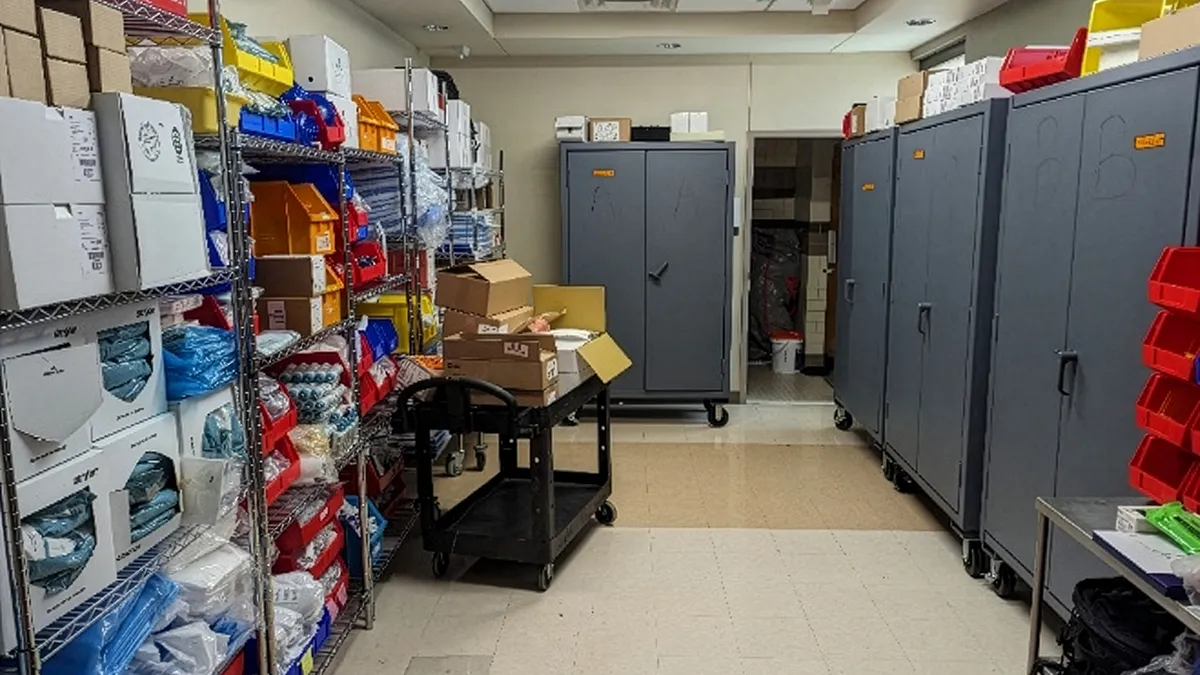
Walter Reed MICU supply room, before transformation

Why BlueBin, and Why Now?
The program’s roots trace back to the early days of COVID-19, when the Defense Health Agency’s head of logistics needed something the Military Health System didn’t have: real-time visibility into on-hand inventory across the board. BlueBin proposed a different foundation altogether, a two-bin Kanban system built to replace automated dispensing cabinets with a standardized, resilient supply chain that would not break under pressure.
A.T. Augusta Military Medical Center, then known as Fort Belvoir Community Hospital, brought BlueBin on for a pilot program in October 2021. The results were immediate and significant, significant enough that the National Capital Region requested BlueBin’s Kanban solution region-wide. Walter Reed National Military Medical Center followed, bringing BlueBin on in October 2023 to build out Kanban across its entire hospital campus.
The results at WRNMMC have mirrored what Augusta demonstrated first: standardized, sustainable supply chain performance, not a one-time fix. That track record is what keeps BlueBin on-site and building at Walter Reed for the foreseeable future.

The Solution
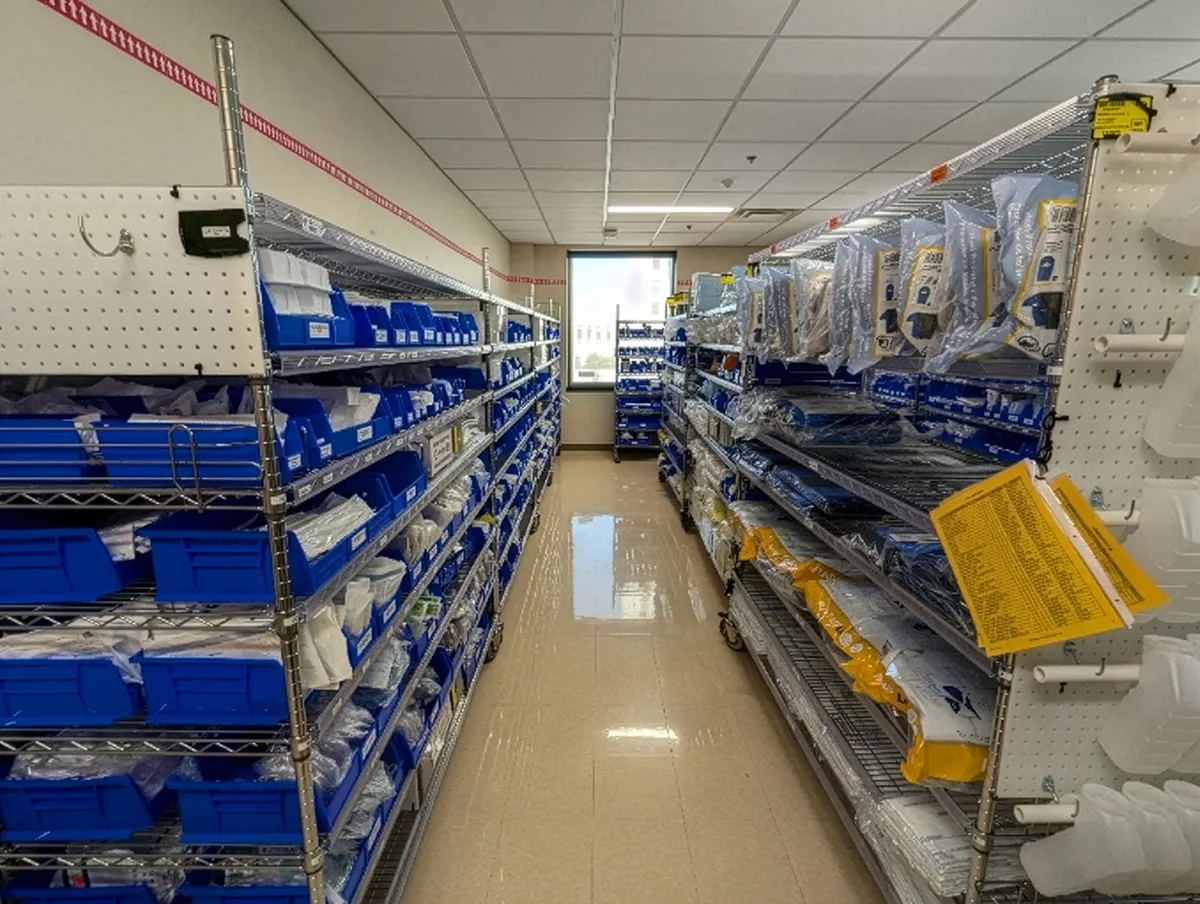
BlueBin implemented its two-bin Kanban replenishment system at WRNMMC beginning in October 2023, with the program currently in its Build Phase and full completion scheduled for September 2026. The open, visual BlueBin racks replaced locked cabinets, unit by unit, giving clinical staff grab-and-go access without a login step, and giving the supply team a physical signal, an empty bin, that triggers replenishment automatically instead of relying on manual counts and orders.
BlueQ Analytics layered visibility on top of the physical system, giving WRNMMC’s supply chain team and DHA MEDLOG leadership a live, data-driven view of fill rates, slow-moving stock, and excess, the foundation for the kind of unified, standardized supply chain transformation DHA has been working toward across the Military Health System.
BlueBin’s program guarantees that the bar set for implementation was measured against: a 5-7% reduction in medical supply expense, 20-30% of supply chain FTEs repurposed to higher-value work, and a roughly 25% reduction in storage footprint. WRNMMC’s results, detailed below, have already surpassed several of these targets, even though the program is still mid-build.

The Results
Between October 2023 and September 2025, WRNMMC’s supply operation changed shape entirely, not just in cost, but in how much of the clinical team’s time BlueBin gave back.

The $5.2M in one-time excess inventory recovered (combining post-conversion excess and excess identified in the MOR warehouse) compares against BlueBin’s total program cost of $2,355,114 at WRNMMC, meaning the one-time excess recovery alone returned roughly 2.2 times the program’s cost, before counting the ongoing annual value of a 79% smaller supply function footprint and zero expired product going forward.
Since BlueBin, I’d say that I have gotten back 60% of my work week that I do not have to spend ordering and tracking down supplies.
TSgt, MICU, Walter Reed National Military Medical Center
That time back showed up across departments, not just in one unit. “I like the openness of the BlueBin racks. We can fit more items than we did with the Pyxis…We hated logging into the Pyxis,” said Daisy, RN, Anesthesia Supervisor. Lettiesha, RN, Internal Medicine, put it simply: “It gets an ‘A’ for convenience. I don’t have to set aside time for ordering or put away anymore.”
SGT, NCO, Pediatric Medicine, gave the system a “10 out of 10,” and the Executive Medical Supervisor described the day-to-day difference plainly: “Overall, BlueBin is great. There is no thinking. It’s grab-n-go. No more logging into the Pyxis.”
The Way Forward
WRNMMC’s program is still in Build Phase, with full completion scheduled for September 2026, and DHA has identified the remaining work needed to fully realize BlueBin’s 5-7% annual supply chain expense guarantee: enterprise-level BlueQ access to DMLSS/Logicol data, continued GETAC scanner readiness at the unit level, and periodic refresher training on Leadership Standard Work (LSW) and the Daily Management System (DMS) that keeps the program self-sustaining.
WRNMMC’s performance to date, alongside comparable results at A.T. Augusta Military Medical Center, is informing DHA’s evaluation of BlueBin as a potential enterprise-wide solution across the Military Health System medical centers and clinics.
Stay tuned for further updates once the program is completed in September 2026.
Ready To Get Started?
Contact us today to discuss your our 2-Bin Kanban systems and supply chain analytics for healthcare!